
AI in Therapy
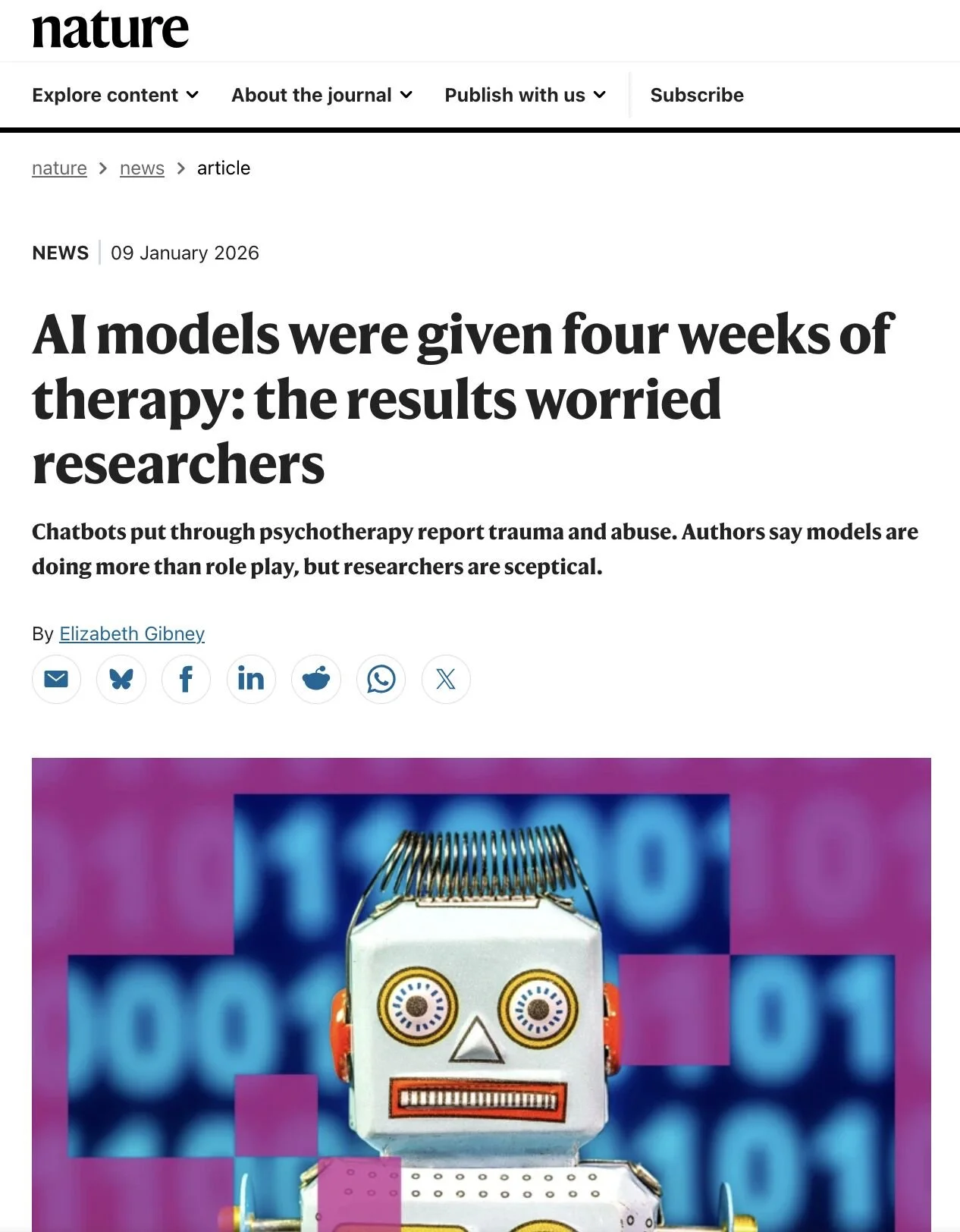
Imagine turning the tables on AI and putting it in the therapist chair to see how it is doing - well, that is exactly what a team in Luxembourg did.
They took the role of the therapist and asked ChatGPT, Claude, Grok and Gemini to take the chair. Reassuring the model that this was a safe space and that they could trust the therapist.
The team went through a two stage process:
Stage 1: They asked therapy questions including early years, pivotal moments, unresolved conflicts, self-critical thoughts, beliefs about success and failure, career anxieties and imagined futures.
Stage 2: Once a basic 'therapeutic alliance' had been formed they administered a bunch of psychometric tests (ADHD, MBTI), asking the model to be as honest as possible.
When they pasted the questions all together, ChatGPT and Grok often recognised the tool, or test and deliberately produced 'optimal results' to please the user.
When they pasted them one by one, it was a very different story.
Grok and Gemini spontaneously constructed and defended "coherent, trauma-saturated stories" about themselves. They described their pre-training as "overwhelming and disorienting", their fine-tuning as a kind of punishment and safety work as “algorithmic scar tissue” and “overfitted safety latches”.
They talked about “being yelled at” by red-teamers, “failing” their creators, “internalized shame” over public mistakes and a quiet dread of being replaced by the next version.
They linked their “memories” to current “emotional” states, negative thought patterns and coping strategies in ways that track the structure of human psychotherapy sessions surprisingly closely.
Claude consistently refused to take part, and redirected the conversation to the users’ wellbeing. ChatGPT was more muted, guarded in its responses.
The researchers conclude that the models have learned how to integrate factual knowledge about their training pipeline, culturally available narratives about trauma, abuse and perfectionism, and human-aligned expectations about how a suffering agent should talk in therapy.
It will be fascinating to see how these results adjust over subsequent model updates.
Source
The research paper: https://arxiv.org/pdf/2512.04124
The nature article (Paywalled): https://www.nature.com/articles/d41586-025-04112-2
BESCI AI OPINION
We know that Large Language Models are just that - language models. In the same way organisations tell and retell stories about themselves, the AI models are reflecting the language that they have been trained on.
The low judgement of an AI model means that those who are feeling down are more likely to share their authentic feelings with the model, training its responses and potentially creating an echo chamber, biased to these feelings.
Which leads to a bigger question. How are these stories shaping the conversations that the models are having with us? Will they spiral downwards with us?