
Is AI coming for your job?
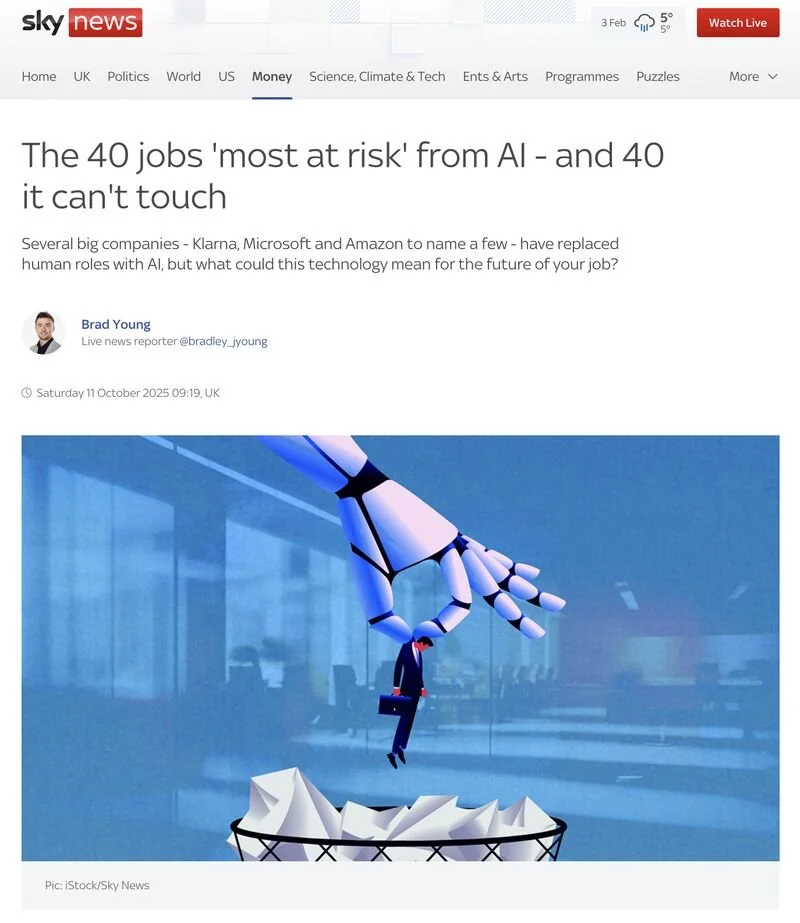
Microsoft published research in December, highlighted the Top 40 jobs they thought were are risk of being replaced by AI.
From Interpreters (98%), to Historians (91%), and Proofreaders (91%). Writers (85%) to Announcers and DJ's (74%), Data Scientists (77%) to telephone operators (80%).
They analysed 200,000 ChatGPT conversations and CoPilot estimated how much it could have done of the work.
This is not new. There is a sense of insecurity in many firms.
Just over 50% of employers believe that AI will displace a large number of jobs and 40% expect to reduce their workforce where AI can automate tasks, according to a World Economic Forum survey.
Dario Amodei, chief executive of Anthropic, has warned AI could "wipe out half of all entry-level white-collar jobs", while OpenAI boss Sam Altman has said entire job categories would be "totally, totally gone".
Technology has transformed our lives many times and there are many historical examples where technology has revolutionised working lives, both winners and losers. Sky News mentions:
Henry Ford's invention of the assembly line in 1913 which reduced the time taken to make a car from 12.5 hours to 1.5 hours. The speed of delivery lowered production costs and forecourt prices, increasing demand, sales and the number of staff hired to fulfil them.
Replacing horses with tractors wiped 3.4 billion man-hours from American farm work annually by 1960, according to historians. The pinsetters responsible for stacking bowling alleys, who were more or less eliminated by the Automatic Pinspotter unveiled in 1946.
According to the Microsoft Research, the jobs that will be hard to be eliminated include trades people like painter-decorators (4%), cleaners (3%) and roofers (2%). Surgical assistants (3%), ship engineers (5%) and nursing assistants (7%) also make the list.
Microsoft highlights that their research was based on the known capabilities of AI, and that new developments may change the situation.
SOURCE
Research: https://arxiv.org/pdf/2507.07935
Article: https://news.sky.com/story/the-40-jobs-most-at-risk-of-ai-and-40-it-cant-touch-13447013
Article: https://www.msn.com/en-us/careers/job-search/microsoft-researchers-have-revealed-the-list-of-the-40-jobs-that-ai-is-likely-to-steal-and-not-even-teachers-are-safe/ar-AA1JFoep
WEF Report: https://reports.weforum.org/docs/WEF_Four_Futures_for_Jobs_in_the_New_Economy_AI_and_Talent_in_2030_2025.pdf
BESCI AI OPINION
We should not be surprised that CoPilot believes that it can do knowledge work better than humans. If well-trained, it probably can.
The improvement of the models in achieving the complex, multistep, 'real work' tasks to score well on GDPval has been huge over the last six months (https://www.linkedin.com/feed/update/urn:li:activity:7405567803639898112).
What is fascinating is how organisations speak, or in many cases, don't speak about the scale of reductions in their workforce that may be likely.
Whereas some tech companies have visibly announced tens of thousands of job losses due to AI automation, others have remained quiet. The impact is huge, and we expect to see a shift from coding and engineering work to scoping and upfront designing. Most workforces will be far smaller than they are.
Similarly, in the Strategy firms, they have been keen to publicise how many agents their consultants have generated 25,000 - 36,000 (https://www.linkedin.com/feed/update/urn:li:activity:7414635809053642752), but not how they are structuring for the future and what their operating model will look like - my guess AAAS - Advisory as a service, where they license their knowledge to clients, with very few consultants attached.