
The BCG AI Assembly Line
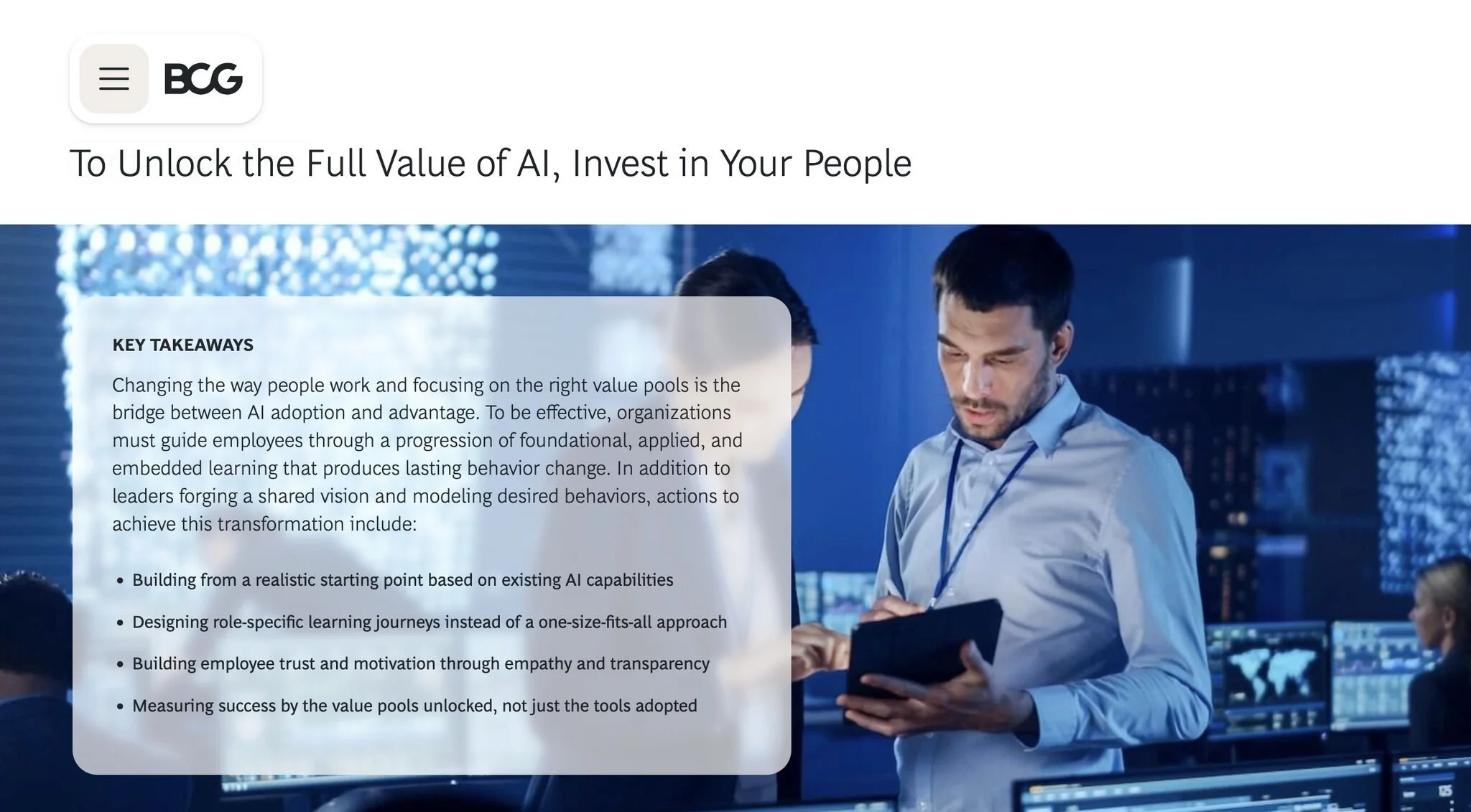
For the last year, BCG has been building what they are calling their AI Assembly Line. Their consultants have built over 36,000 Custom GPT's in the last year - they claim to be a top creator in the field.
The pivot from consulting to tech providers is not new. Many of the strategy firms have been buying up technology platforms and companies to gain more of the value chain and reposition themselves.
BCG have a three layer focus for their AI assembly line.
1. Foundation Layer: Collating their internal data, their presentations, document and reports.
2. Middle Layer: Their consultants are actively encouraged to create AI tools working on client projects. 80% of their custom GPTs are created here. If the tool works well, it’s handed over to the R&D team to be polished and shared.
3. Top Layer: Firm wide tools for use by everyone. So far they have about 7-8 of these including presentation creation, IT/HR support and internal communication and marketing.
BCG has built a 1,000 strong enablement network including teams from HR and legal. The network acts as internal trainers and AI champions, meeting monthly to share good practice.
This is not new, or unique to BCG.
McKinsey launched it AI tool Lilli in 2023 and by spring 2025 over 70% of the firms 45,000 employees were using the tool.
Lilli synthesizes their entire body of intellectual property, which spans 100 years and over 100,000 documents and interviews. When asked it will identify 5–7 pieces of content and point the user to the experts in the firm.
Back in 2015, McKinsey it acquired a data analytics and design company, QuantumBlack, which has become its AI consulting arm.
SOURCES:
Original Article from Hack Diversity: https://www.hackdiversity.com/inside-bcgs-ai-product-assembly-line/
BESCI AI OPINION
With a clickbait headline talking about AI assembly lines and 36,000 Custom GPT's this sounds like a good thing, right
Then you dig deeper and your heart sinks.
After a years focus by one of the top strategy firms, the 7-8 firm wide agents that have been deployed are for HR/IT support, creating presentations and shaping internal communications.
What about the amazing advice and tools that they could be building for their clients, or the knowledge base that they are using to get to that advice quicker?
With 36,000 Custom GPT's and only 7-8 deployed firm wide, there is a big gap.
As a change agent this feels like a 'not invented here' problem - where there is low trust, low collaboration, and high competition between teams.
Pockets of expertise are staying as pockets. They are struggling to convert them to enabling solutions. It is a behavioural and cultural barrier, not a technical one.
Strategically, we see the future as being Advisory as a Service, where firms will license their knowledge and agents to clients, without the need for their associates. Like we do at Irrational Change.
Delivering even highly technical advice now happens in minutes instead of weeks, yet there are still a lot of associates.
At CES in Jan 2026, the McKinsey Boss announced that they have 25,000 agents and that he considers them like headcount, giving him a workforce of 60,000.
Although this could be seen as posturing (I have more agents than you do). It still holds a messy truth - there probably aren't 25K use cases - there is likely to be a lot of duplication, and siloed behaviour, which is inefficient.