
Leap into the Future
Rethink the past, leap into the Future
When we experience unprecedented times and there is a technological, political, economic or societal dynamic that threatens our industry we have three choices
Continue as-is, stay the course
Incremental, low risk changes
‘Leapfrog’ strategy, using the opportunity
We brought together some of the best change minds to understand what holds us back, what sets us free and where you should invest to become ‘Leapfrog’ ready
This paper is what they had to say.
Download the full changeXchange paper:
What really holds us back
The reasons we hold onto the past.What sets us free
The enablers that need to be in placeWhere we should invest
Build an adaptive organisation, focus your efforts.Leapfrog Readiness Assessment
Assess what is holding your organisation back.Diagnostic tactics
How to become ‘Leapfrog’ ready.
What is a ‘Leapfrog’ Strategy?
A transformational strategy that skips the steps that others might make and makes a big ‘Leap’ into the future, learning from, but not being held back by the past.
In parts of Africa, they skipped landline telephones and leapt straight to cellular communications.
In times of technological breakthroughs, new opportunities open up.
Competitive advantage may be achieved by those who quickly adopt and apply them in a native setting, whilst incumbants try and adapt.
The flexibility and agility needed to adapt are strategic capabilities and choices any organisation can invest in.
This paper identifys the causes of inertia, assess your Leapfrog readiness and build enablers for the capability.
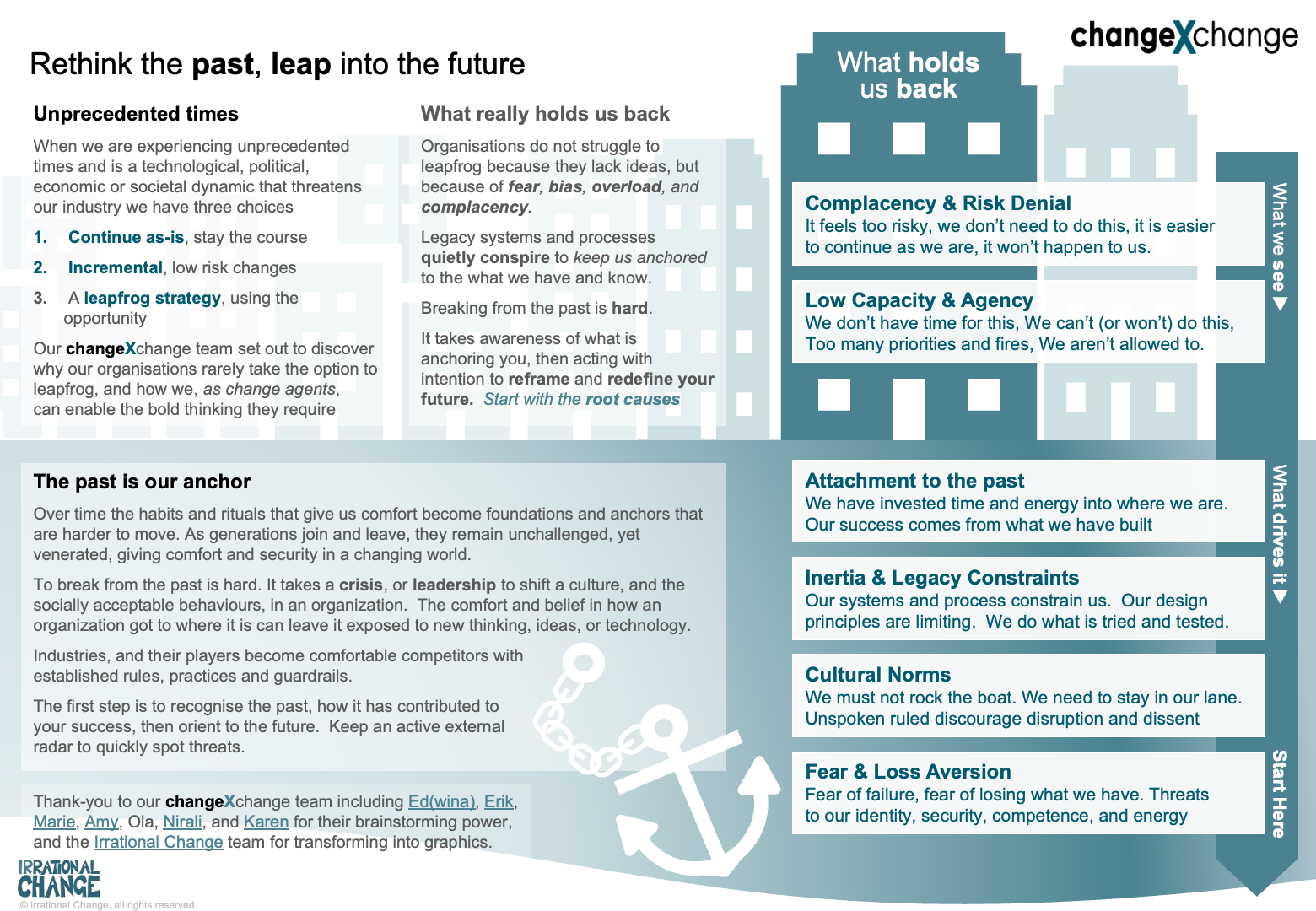
What Holds us Back
We started by asking what holds us back. What keeps us in the status quo, or focused on incremental change? Our aim; to get to the root causes.
The causal tree suggests that:
Complacency and Risk Denial
It feels too risky, we don’t need to do this, it is easier to continue as we are, it won’t happen to us.
Is a visible and tangible barrier, but is an effect, not the cause. It is a data point that you may not have the flexibility you need.Low Capacity & Agency
We don’t have time for this, We can’t (or won’t) do this, Too many priorities and fires, We aren’t allowed to.
Capacity is a strategic choice, and if we aren’t allocating capacity, then it isn’t important to us. It is a sign, not a cause.Attachment to the past
We have invested time and energy into where we are. Our success comes from what we have built.
We value things we have invested in (IKEA bias) and we hate to lose what we already have (loss aversion), because it is too hard to assess the risks that might come with the loss.Inertia & Legacy Constraints
Our systems and process constrain us. Our design principles are limiting. We do what is tried and tested.
We build systems, measures and processes which give predictability and a sense of being in control. The same systems are often designed to reduce variability, flexibility and innovativeness.Cultural Norms
We must not rock the boat. We need to stay in our lane. Unspoken ruled discourage disruption and dissent.
Tribal dynamics and habits loom large. We are comfortable doing what we do and there isn’t a clear model for what different might look like. We avoid the threat and risk of different.Fear & Loss Aversion
Fear of failure, fear of losing what we have. Threats to our identity, security, competence, and energy
Fear sits at the heart of our inertia. Fear that our safety, status, identity or energy might be threatened.
If we don’t address the fear and need for safey, we will never create an agile and flexible organisation capable of a Leapfrog strategy.
What Sets us Free
If the fear, habits, and an investment in the past hold is back, what enablers will set us free and create an organisation with the flexibilty and agility to jump into the future and be competitively advantaged.
Psychological Safety, Willing to Experiment
We feel safe when challenging assumptions, making mistakes and trying new things.
Unsurprisingly, the core element is a feeling of being safe, and that it is OK to try new things, take risks, experiment and possibly fail. Fail fast and forward.Trust, coherence and healthy challenge
We trust each other, enabling constructive disagreement and conflict to reach consensus.
Change happens at the speed of trust. It is the magic glue that enables organisations to move quickly, and coherently. It enables disagreement and constructive conflict so that diverse views are heard.Agency, Self Belief and Empowerment
Willingness to take risks, action, and influence outcomes without asking for permission.
Empowerment is a product of trust, it helps us feel in control and that we have agency over our choices.Breaking Patterns and Constraints
Letting go of limiting beliefs, disrupting habits, norms, traditions and rules. Creating a different environment.
Our habits and rituals give us comfort, disrupting the feels risky. Safety, trust and empowerment create the environment where patterns and constraints can be challenged constructively.Future Clarity and Shared Intent
Clear vision, orientation towards a shared future with coherence, alignment and confidence to act.
Clarity drives outcomes. Having a clear sense of where you are trying to get to, or even the competitive challenge you are facing enables teams to work coherently. Trust, safety and empowerment drive collaboration and reduce competitiveness.Learning, Experimentation & Curiosity
Iterative and exploratory. Relying on learning through doing, testing assumptions and reframing problems.
Curiosity, creativity and experimentation exist where you feel safe, empowered and respected. Where you can try new things, challenge old things and thinking.
Protected Capacity, Flexibility
Make the space, protect time, attention and resources. Prepared to make a short-term sacrifices.
If you have the enablers in place, you will naturally protect the capacity and build the flexibiliy, you will be comfortable making the sacrifices and feel empowered to do so.
Build the enablers ahead of time. Trying to create safety or trust in times of crisis can feel transactional and mistimed. Invest ahead.
Where you should Invest
The pace of change and level of competitive and strategic threat is likely to continue. With a feeling of chaos, it can be hard to predict. In times of uncertainty, build the culture and skills that you will need to adapt and take advantage of the competitive situation.
Start here:
Build each level as a foundation, before adding the next.
Trust, Psychological Safety, Authenticity: Feeling safe, respected and able to be authentic. Felt personally, before it is felt organizationally.
Inspiring Leadership, Role Modeling: Leaders people want to follow, emotionally. A visionary, that proactively creates the future.
Capability, Confidence and Lived Success: Confidence grows through new experiences, feeling capable, and being recognized.
Freedom within a framework: Autonomy, with empowered guardrails and clear intent creates momentum. Incentivize curiosity.
Emotional Legitimacy and Humanity: Leapfrogging is emotionally demanding. Create space to lead with love, courage and emotions.
Collective Intelligence & Idea Collision: Breakthroughs happen when different perspectives and diverse opinions collide, it is a social process.
Play, Creativity & Disruption: Disrupt normal thinking with playfulness, creativity, disruptively different environments and choices.
Protected Capacity & Separation: Create space for innovation, intentionally, structurally and psychologically. It matters
Assess your Leapfrog Readiness
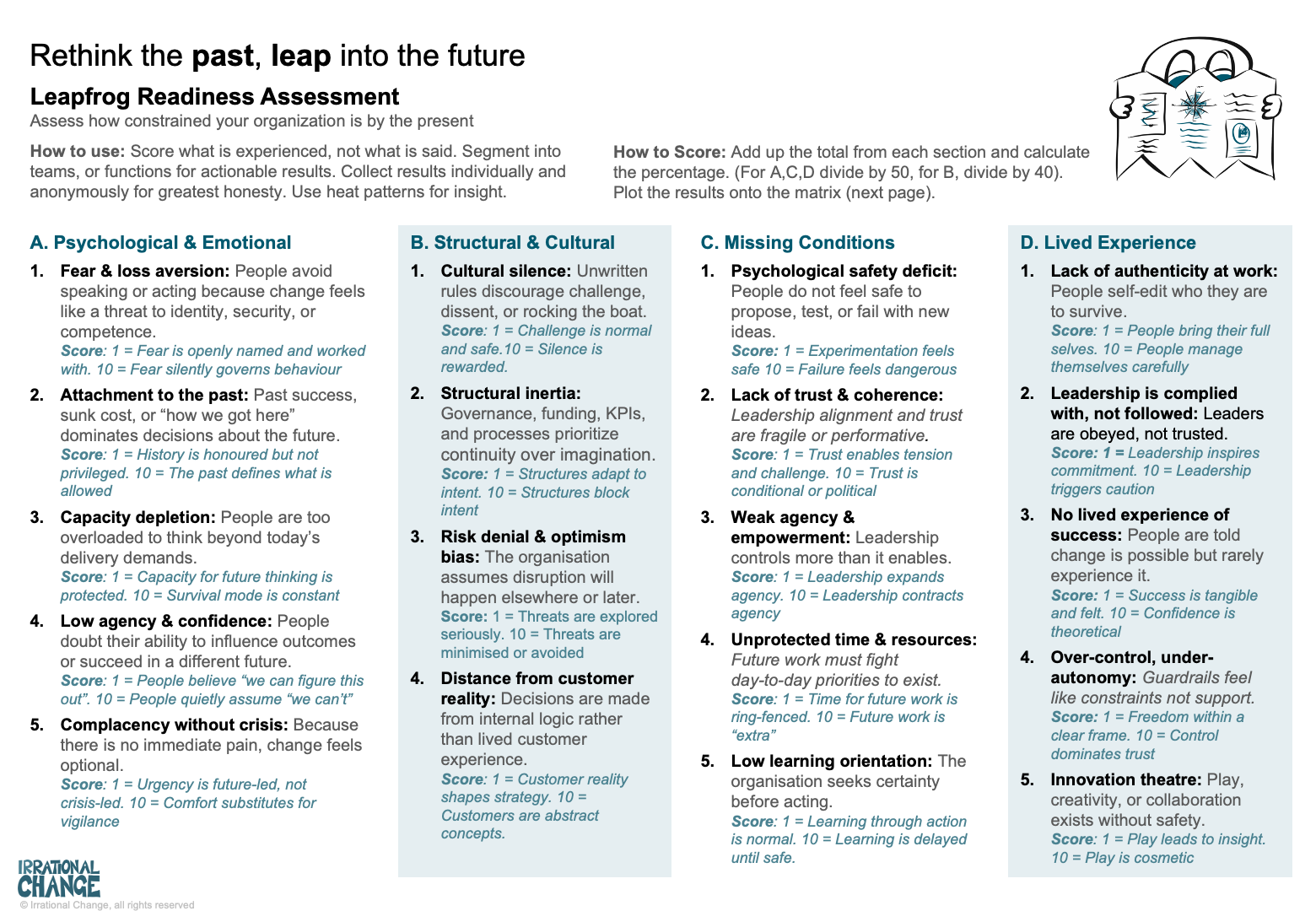
Use this assessment tool to assess your Leapfrog Readiness.
How to use: Score what is experienced, not what is said. Segment into teams, or functions for actionable results. Collect results individually and anonymously for greatest honesty. Use heat patterns for insight.
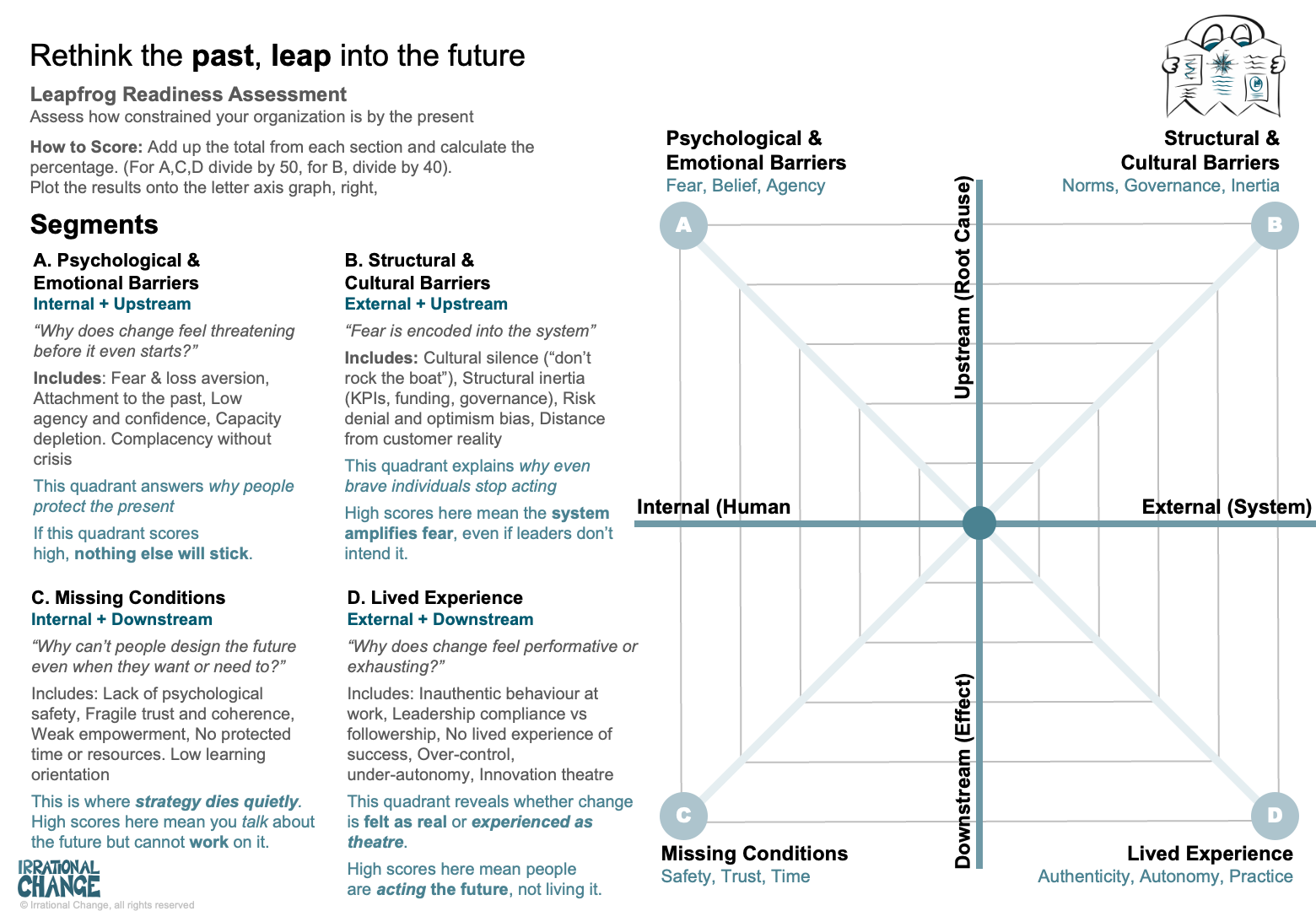
How to Score: Add up the total from each section and calculate the percentage. (For A,C,D divide by 50, for B, divide by 40). Plot the results onto the matrix and assess against the Diagnostic Patterns.
Assessment Tool
Result Matrix
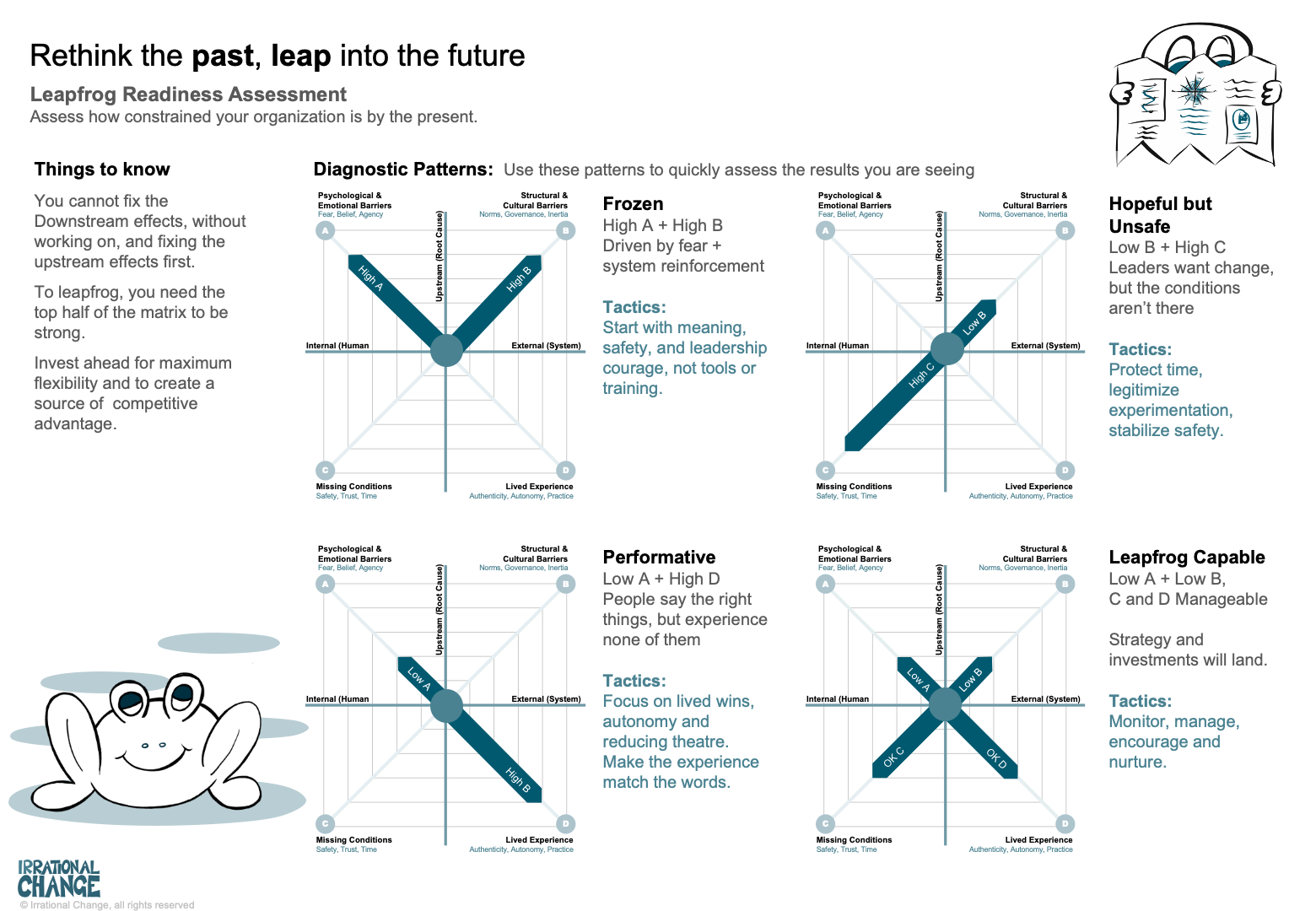
Diagnostic Patterns.
Thank-you
A big thank-you to our changeXchange team including Ed(wina), Erik, Marie, Amy, Ola, Nirali, and Karen for their brainstorming power, and the Irrational Change team for transforming into graphics.
This paper is provided under the creative commons license, for your own use and not for commercial gain.