
The Widening AI Value Gap
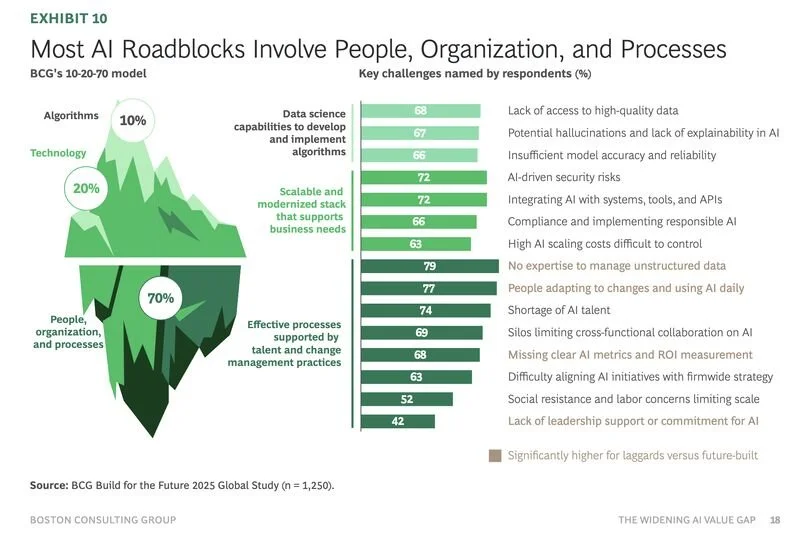
Back in September, BCG published their 'The Widening AI Value Gap' report, to highlight what the winners and losers in the race to be AI native were doing, what was working and what wasn't.
Unsurprisingly, those who were winning, were investing more heavily in AI, moving out of the back office, into the front office, using agents and were 12x more likely to have senior executives and leadership teams who are deeply engaged with AI.
They are dedicating time, people and budget behind AI, making sure that the guardrails are in place.
The three winning principles are not AI related at all, they relate (unsurprisingly) to any large scale, strategic transformation and include:
→ Shared Ownership: Between business and IT.
→ Top Down Removal of Roadblocks: Making the tough calls and sacrifices.
→ Visible, Outspoken Exec Leadership: Walking the Talk.
For some industries (tech, legal, financial and advisory services), AI truly is a game changer and the risk of disrupters is high.
The AI Roadblocks are driven by the same things that many other transformations suffer from:
→ Quality of Data (68%), Unstructured data (79%)
→ People adapting (77%)
→ Silos (69%)
→ Social Resistance (52%)
Leadership resistance rates lower than we would expect at 42%, which we believe may come from the responders being overly kind to themselves.
With a small sample size of 1250 respondents, they are balanced across regions, mostly with a turnover of $1bn+. They are predominantly C-suite, Heads of Division or Execs/VP's.
Source
Source: https://media-publications.bcg.com/The-Widening-AI-Value-Gap-October-2025.pdf
BESCI AI OPINION
Adoption is a human problem, not a technology one. To go one step further it is a human willingness, not one of ability.
Whilst the BCG teams highlight the need for leaders to set the tone, over half the respondents (leaders) feel that they are enablers, not blockers. If this was the case, their results may be very different.
The elephant in the room for many organisations is the medium to longer term impact on their workforces. Few will, or can speak openly about the impact, in the full knowledge that it will destabilize their organisation even further and risks leading to talent loss before they are ready.
It is too late to think about building flexibility and adaptability into your teams. The risk of disruption to your industry is too great, and there is a good chance you won't spot it until it is too late.
Here are some signs that you might want to look for, as leading indicators, or predictors of being slow to respond:
→ Silos, poor cross-functional collaboration
→ Focus on short term goals, over longer term strategic direction
→ Efficiency programs removing capacity, and flexibility
→ Slow decision-making, limited risk taking
→ Committees, delegated leadership, disconnected 'sponsors'