
When the past has hidden depths
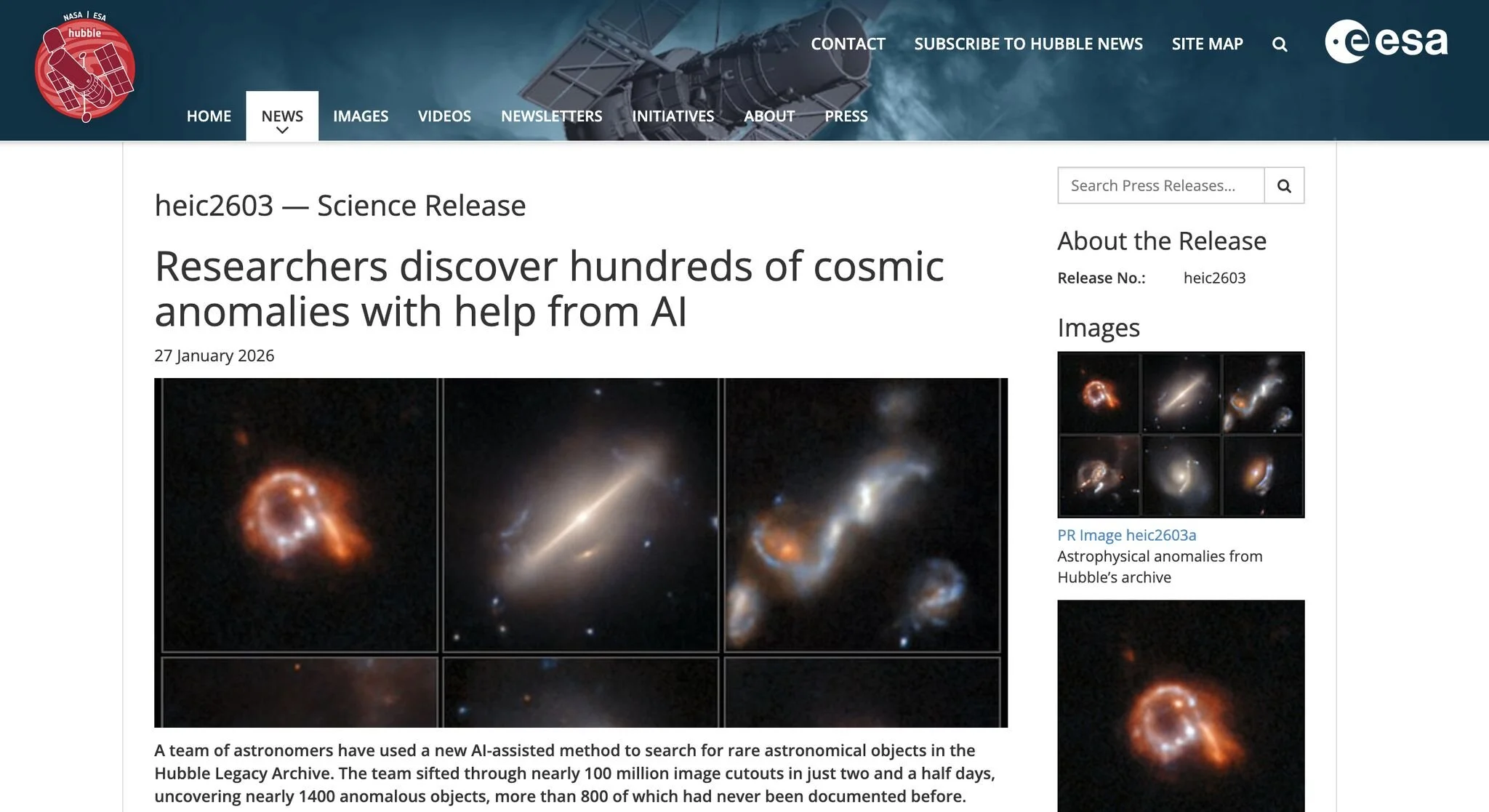
If you have ever dug through your phone photo album looking for something, you can appreciate the work the European Space Agency did recently.
They took the Hubble Legacy Archive, nearly 100 million images taken over 35 years by the Hubble Space Telescope, and used AI to search for rare astronomical objects.
And it found them, in just two and a half days.
It found 1400 anomalous objects, 800 of which had never been documented before. Objects like colliding galaxies, gravitational lenses and ring galaxies which are of immense scientific interest, but are difficult to find in the growing masses of data. They are the cosmic needle in a haystack the size of the Universe.
If you have the data, there may be something in there that you are missing, that can be brought to life. Maybe it isn't a new galaxy, but it might be insightful.
Source
https://esahubble.org/news/heic2603
BESCI AI OPINION
This reminds me of a regular conversation we have with our clients, who are looking at new processes and systems, to improve decision-making. Their aim is to collate data in a way that will inform and nudge the decision makers to act more decisively.
We often ask whether the data sits somewhere, it often does.
If it does, then AI can do a very credible job of collating it, and tailoring it to present with the right levels of risk, or persuasion, with choices, without disrupting the existing process or systems. If the data is available.
What is your data footprint and are you using it effectively?